What Is That Hip Pinch?

Have you ever experienced an annoying “pinchy” sensation in the front of your hip? Many patients are referred to physical therapy for other regions of the body (back pain being the most common) and mention this uncomfortable sensation in passing.

Typically this occurs with movements like deep squatting. This “pinch” occurs as the ball of the hip (the femoral head) glides forward excessively and presses against the soft tissues located in the front of the joint.

This forward movement is normal however it is important be mindful of where the socket of the joint (acetabulum) is positioned as well.

Often times, pinching occurs in the front of the hip due to a poorly positioned hip socket.

The good news is that we can reposition the hip socket so that your hip does not pinch as easily!

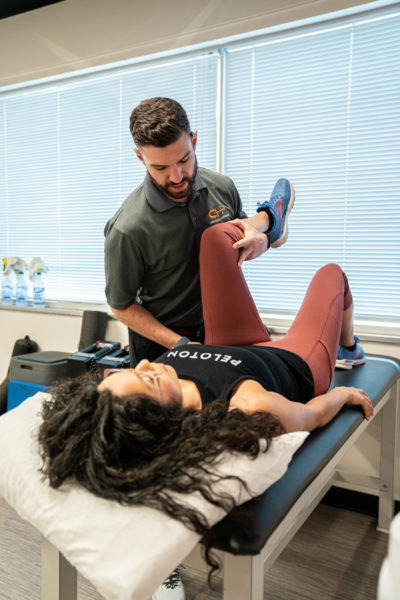
There are many great drills that help with this however the Shifted Single Leg 90/90 Hip Lift is a great one to start with (this is also a great movement to get the hips/pelvis moving before running). In this video, the left hip socket is being oriented into a position that will result in less pinching.

  1. Start by lying on your back with hips/knees bent at 90 degrees and feet on a wall
  2. Slowly pull your heels down towards the ground as you reach your knees towards the ceiling. Your tailbone will slowly lift off of the ground and you should begin feeling your hamstrings working.
  3. Without moving your feet, shift 1 hip/knee down as the other hip/knee shifts up. As you shift one hip/knee down, ensure that you are pulling towards the ground with that heel. You should feel that specific hamstring cooking at this point!
  4. Pick the opposite foot up off the wall while maintaining the hip shift
  5. Hold this position while taking a relaxed breath in through the nose, followed by a long exhale out through the mouth before pausing for 5 seconds. Perform this for 5 cycles.

As with all exercises, they should be specifically tailored to your particular needs and unique physical qualities. Schedule a FREE phone consultation with a member of our physical therapy team on our website to determine how to most effectively implement an exercise like this into your program!
Lower Body Gains with Back Pain (video included)

Back pain is the most common diagnosis seen in the sports physical therapy and injury rehabilitation settings (pretty common with runners too!). People with cranky lower backs often have to manage the total volume of activity being performed over a given period of time.

Notably, it is essential to be mindful of the number of exercises being performed that involve a great deal of axial loading. Axial loading involves weight bearing directly downward onto the spine.

Drills that contain a lot of axial loading typically have the weight supported on the shoulders (ex. barbell squats).

While (for those of us with back pain) it is important to keep the volume of axial loading within reason, reducing the number of exercises that can be performed present limitations for those of us that want to make gains in the gym.

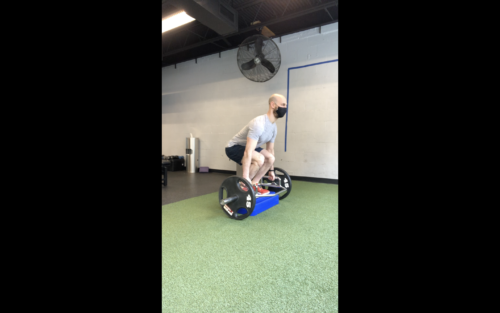
The trap bar squat is an awesome drill that works the legs and when performed correctly, leaves the back feeling fresh!

1) Assemble a trap bar so that a box is in the center of the bar

2) Stand on the box and inside of the trap bar

3) Exhale to bring the ribs down in the front and feel the abs

4) Inhale as you squat low enough to reach the bar by pushing the knees forward-this is not a deadlift!

5) Reset your abs if necessary, tack the slack out of the bar and stand tall as you exhale

6) Repeat

Please contact us to learn more about how you can make improvements in the gym while keeping your lower back healthy!

Train Your Way Out of Knee Pain

Seems counterintuitive right?

When your knees are cranky, how could using these joints more be helpful? Many of our patients share these same questions when during the injury rehabilitation process as they begin physical therapy.

Knee pain often originates from a reduced ability to tolerate stress. This stress may occur during movements such as squatting, lunging, running, or jumping.

Every tissue in the body has a stress tolerance. This is the amount of stress or loading that the tissue can tolerate before pain and injury occur. If the stress or loading tolerance reduces, less stress is required for pain or injury to occur. However, on the flip side, when the loading tolerance of a tissue increases, it then is capable of tolerating more stress. Sports physical therapy is often a balancing act between these factors.

The only way to increase loading tolerance is to train (or stress) the tissue!

The key is ensuring that the correct amount of stress is being administered to the target tissues. Too little stress will not be enough to force the body to adapt while too much may result in further injury.

Think of it like weight training. To build bigger muscles you must lift weights which is stress to the muscles. This triggers an adaptation to better handle the stress that was applied to it.

In cases of chronic knee pain, it is common for people to intentionally avoid loading the knees. As this occurs for extended periods of time the loading tolerance of the tendons and the various tissues surrounding the knees begin to decrease. This decrease in loading tolerance then increases the likelihood of further discomfort creating a snowball-like effect.

We can reverse this trend by introducing pain free exercises that force the tissues around the knees to work hard. These commonly include isometric exercises which are drills that involve holding a challenging, stationary position for an extended period.

Another category of exercises that often help those with chronic knee pain are eccentric exercises. Eccentric exercises force tissues to work as they are slowly lengthening. The exercise below is an example of one of my favorites that we commonly use.

Eccentric Step Ups

When it comes to knee pain, there are no “good” or “bad” exercises. The key is finding the exercises that provide the optimal amount of stress so that the surrounding tissues adapt properly.

Our team of Performance Physical Therapists would love to help you discover the best exercise routine to improve the loading tolerance of your knees. Contact us to receive your comprehensive home program today!

P.S. Subscribe to our youtube page and check out our new and improved Instagram page @cohenhealthandperformance

What Touching Your Toes Really Says

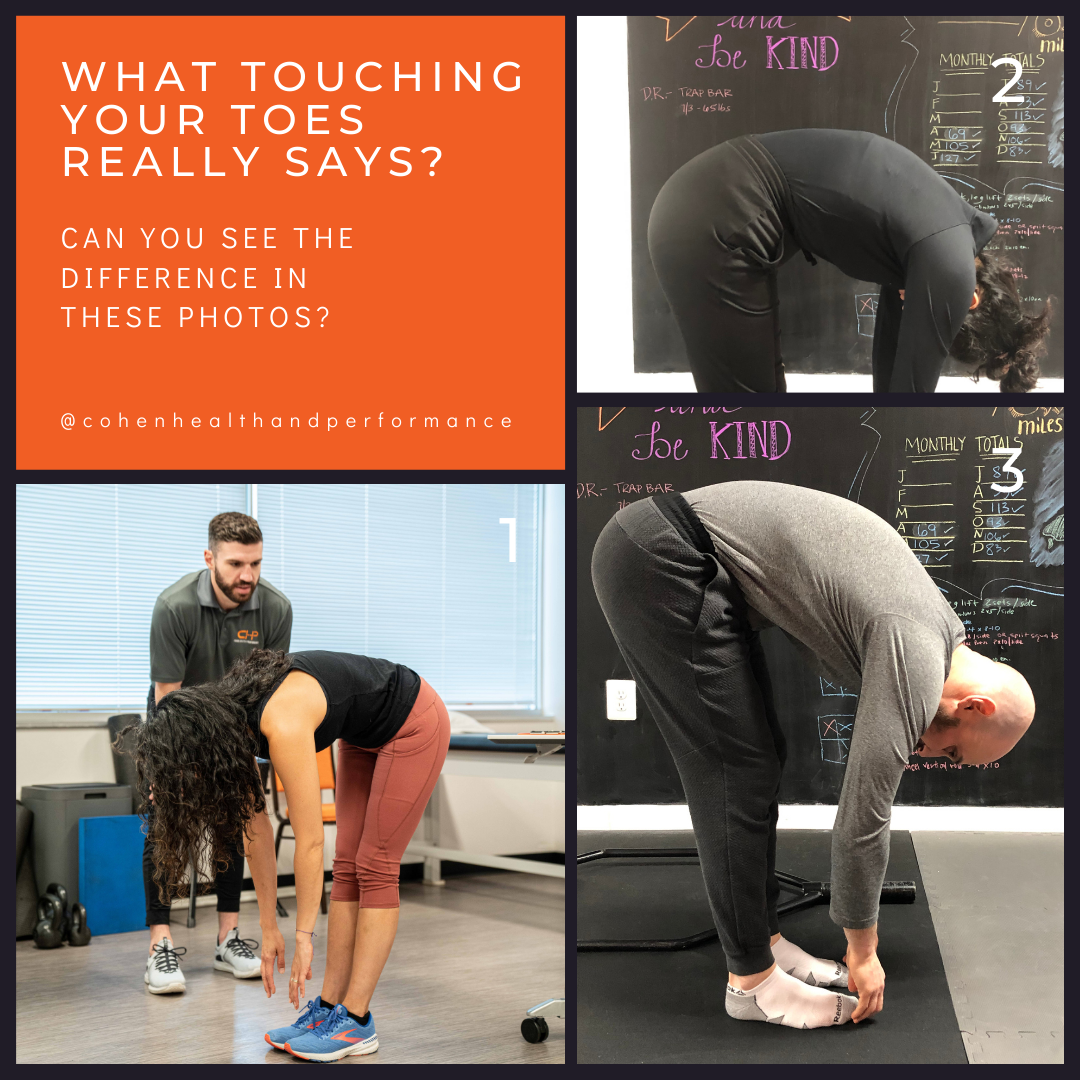
Can you see the difference in these photos? The toe touch is a simple test that is often performed in injury rehabilitation and sports physical therapy settings.

However, important parts of this test are commonly missed. Simply touching your toes doesn’t tell the whole story. If you can touch your toes, great, however there are different ways that you can get there.

Have you stretched your hamstrings to such a degree that they allow you to nearly palm the floor? 

If you are a gymnast that may be a great thing. However field sport athletes (ex. Lacrosse, football, basketball, baseball) and weight lifters need a level of hamstring stiffness for explosive movement. 

Is your lower back straight or does it flex into more of a C curve to allow you to more easily touch your toes? Is your lower back bending in certain areas but not in others?

Your lower back consists of multiple bones (vertebrae) that are stacked on top of each other. Our backs are built this way to allow for movement of one segment on the next. However many times these small movements do not occur and the lower back moves as one unit. The result is a lower back that looks straight in places despite being bent over. Over time, a lack of lower back  movement can increase the risk for injury.

The toe touch is a great test and can be made even better when directed by a professional with a trained eye.

Contact us for more information about how a customized movement assessment may help you optimize your training and avoid injury!

What The End Of My Sports Career Taught Me

Boy have times changed. Look at all that hair! Apparently they couldn’t do anything about the sun on picture day…

“I need to stretch more. Maybe I should try Yoga.”

“I’ve heard Pilates is really good for my core. Maybe I need to check out a class?”

“Strength training is important so perhaps I need to start lifting weights but where do I start?”

Most of us have had thoughts like this when considering different types of exercise.

The world of health, fitness, sports physical therapy and injury rehabilitation is huge and may seem overwhelming. I recall when I felt confused about how to proceed with my fitness journey.

After finishing my college football career, I no longer had coaches to guide my training. No longer did I have prescheduled practice, conditioning workouts, weight training, and recovery workouts (usually a mixture of foam rolling, stretching, yoga and light cardio).

I was unsure of what to do so I simply continued training as I always had. I lifted weights as per my usual off-season program and performed a couple conditioning workouts per week.

After a few weeks of doing this, I decided to ask myself a simple question. “Why?”

What was my training goal now? What were the best ways to achieve these goals? Upon some reflection and jotting down a few notes I quickly realized that my training program was not in line with my goals at that time.

My football career was over. I finally had the opportunity to get healthy and stay that way.

However, I really enjoyed feeling strong and the process of lifting weights. Also, I was studying to become a Certified Strength and Conditioning Specialist (CSCS) so had to practice what I preach (this was prior to physical therapy school).

I decided to create a strength training program that consisted of exercises to promote strength, while also improving my mobility. The goals were to improve my strength and muscle mass, while feeling great overall.

This was the optimal training approach for me at the time and I was only able to realize that by slowing down and asking a few simple questions.

When was the last time you did that? Try asking yourself the following questions.

  • What are the outcomes that I am looking for from my training? Do I want to become stronger? Do I want to live with less discomfort? Become more mobile? The key is being honest here!
  • What are the best ways to achieve the outcomes I am looking for?
  • If I am not sure of #2 above, who can help me figure that out?

As you can see with question 3 above, you do not need to have all the answers yourself. There are many people out there available to help you reach your goals but no one can determine what those goals are.

Once you gain clarity about your goals, our team of Performance Physical Therapists in Chevy Chase would love to help you achieve them. In addition to being Doctors of Physical Therapy, our team of Performance Physical Therapists are Certified Strength and Conditioning Specialists that specialize in helping injured athletes get back in the game.

Ergonomics Are Overrated (Maybe)

Blasphemy! Every physical therapy professor from Bethesda to New Zealand just made me public enemy number one.

I am exaggerating, of course, however it sounds outrageous for a sports physical therapist or anyone working in the injury rehabilitation field to state that ergonomics could be overrated.

This is not to say that they are not important. An individual’s workplace setup, for example, is an important factor to consider when addressing ailments such a chronic neck or back pain.

However, if you look on social media or watch an episode of shark tank, you are likely to find several different devices claiming to fix your posture and solve your pain. Many then purchase these products and become discouraged when their ailments are not cured.

Claiming that a single ergonomic correction will solve all your issues is to ignore the myriad of different factors that contribute to pain or injury. Furthermore, it ignores the fact that there are other, more influential factors.

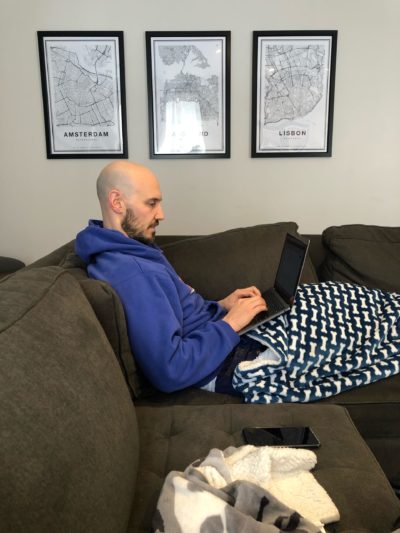
Look at the picture above. An ergonomic specialist would give me a failing grade. I am slouching and looking down at my computer with my legs stretched straight out. Even worse I’m resting my computer on my poor pup, Chip (he is under the blanket)!


However, I’m feeling pretty good today. I slept well last night and went on a long walk this morning after exercising. These factors outweigh the impact of an hour of computer work.

Improving large components of health such as sleep, nutrition, exercise, and stress enhance the resilience of our bodies.

Resilience is an awesome thing. It creates room for error and means that we can still feel great despite having an imperfect desk set up.

Overall, it is worth repeating that you should still try to improve ergonomics whenever possible, however do not expect it to solve much when the larger components of health are being ignored.

For more information on these larger components of health, check out the articles below!

Does Your Metabolism Actually Slow As You Age?

Benefits of Walking for Physical and Mental Health

Exercise Stacking

×